

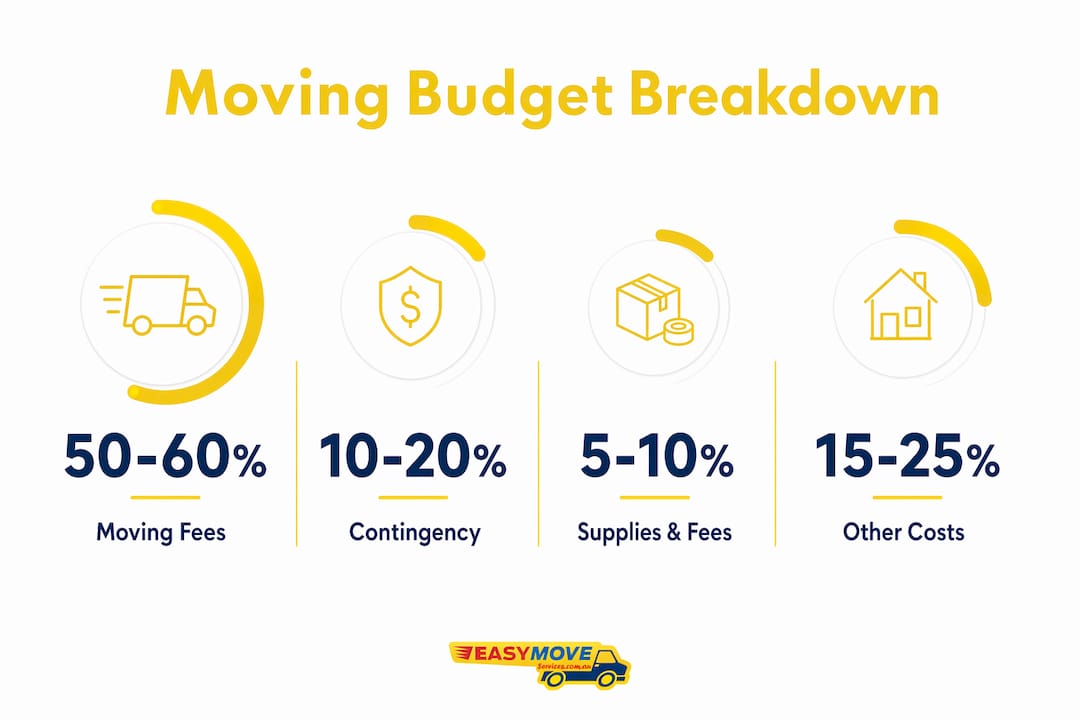
Budgeting for moving costs means planning for every expense beyond the removalist’s quote, including deposits, packing supplies, travel, and a contingency fund, so your family avoids financial surprises on moving day. A complete local move typically costs between $3,000 and $8,000, while long-distance relocations range from $6,000 to $25,000 depending on home size and distance. The single biggest mistake families make is treating the removalist’s invoice as the total bill. Moving services generally represent just 50–60% of the actual cost. Getting the full picture early is what separates a smooth relocation from a stressful one.
How families budget for moving costs: the full expense breakdown
The removalist fee is the most visible line item, but it rarely tells the whole story. Moving services account for 50–60% of a total moving budget, with security deposits and initial rent or mortgage payments adding another 10–20%. That means nearly half your budget goes to costs that have nothing to do with the truck or the crew.
Packing supplies, cleaning fees, utility connection charges, and travel costs typically consume 5–10% of the budget. These feel small individually, but a family of four moving from Melbourne to Brisbane will spend hundreds on boxes, tape, bubble wrap, and cleaning products before a single item leaves the house. Tipping removalists is also standard practice and worth factoring in.

The category most families forget entirely is the contingency fund. Financial advisors recommend setting aside 10–20% of your total budget for unexpected costs such as storage extensions, last-minute packing help, or rush delivery fees. This fund must sit separately from your everyday savings and emergency reserves.
A practical way to build accuracy into your budget is to conduct a room-by-room inventory before requesting quotes. Itemised inventories uncover hidden costs like specialty item handling fees for pianos, pool tables, or large appliances. Families who skip this step routinely receive quotes that balloon on moving day.
Pro Tip: Use a spreadsheet with one tab per cost category. Assign a low and high estimate to each line item, then plan to the high figure. Any money left over becomes your contingency buffer.
How can families save money on moving costs without sacrificing quality?
Timing is the single most powerful lever families have when it comes to reducing moving expenses. Choosing off-peak periods between september and april, and booking mid-week rather than on weekends, can reduce removalist rates by 15–50%. That is a significant saving on a budget that might otherwise reach $15,000 or more for a large interstate move.
Decluttering before you pack is the second most effective strategy. Every box you do not fill is a box you do not pay to move. Sell, donate, or dispose of furniture, clothing, and appliances you no longer need. A family that reduces its load by even 10–15% can drop to a smaller truck size, which directly cuts the removalist fee.
DIY packing or a hybrid approach, where you pack non-fragile items yourself and leave breakables to the professionals, reduces labour costs without increasing risk to your belongings. Sourcing sustainable packing materials such as reusable crates, recycled boxes from local supermarkets, or padded blankets instead of single-use bubble wrap also trims the packing budget.
Always request at least three written quotes before booking. Binding estimates lock in the final price and protect your family from cost increases on moving day. Non-binding quotes are a common source of budget blowouts, so insist on binding figures in writing before you sign anything.
Pro Tip: Book your move at least six to eight weeks in advance. Last-minute bookings in peak season not only cost more but also limit your choice of reputable removalists.
What common budgeting mistakes do families make?
The most widespread mistake is budgeting only for the removalist’s quote. Families underestimate total costs by 30–50% when they focus solely on the mover’s bill and overlook deposits, utilities, cleaning, and new home essentials. The mover’s invoice is just one piece of a much larger financial puzzle.
Mixing relocation spending with everyday household finances is another costly error. When moving expenses flow through the same account as groceries and school fees, families lose visibility over what they have spent and what remains. Keeping relocation spending separate from daily finances is a standard recommendation from financial advisors, and for good reason.
Booking during peak season without comparing off-peak alternatives is a mistake that costs families hundreds, sometimes thousands, of dollars. The seasonal impact on moving costs in Australia is well documented. Rates spike between mid-may and mid-september, particularly around school holidays and end-of-lease periods.
Failing to account for upfront costs is a fourth pitfall. Even families with employer relocation packages face a temporary cash gap. Upfront costs including deposits and initial rent commonly reach $8,000 to $20,000, and reimbursements or new paycheques rarely arrive before those bills are due. Plan for this gap explicitly.
Pro Tip: Never accept a verbal quote. A binding written estimate is your only protection against a removalist increasing the price after your belongings are loaded onto the truck.
How should families plan and manage paying for moving costs?
Structured financial planning turns a stressful relocation into a manageable project. The steps below give your family a clear framework for moving expenses planning from start to finish.
-
Start saving at least three months out. Calculate your estimated total budget, including the contingency fund, and divide it by the weeks remaining before your move. Set up an automatic transfer to a dedicated relocation account each pay cycle.
-
Open a separate relocation fund. This account holds only moving-related money. It prevents overspending, makes tracking straightforward, and gives you a clear view of your remaining budget at any point.
-
Clarify employer relocation assistance early. If your move is work-related, ask HR whether a relocation package is available. Employer relocation packages are treated as taxable income and may attract 25–35% in tax deductions unless a tax gross-up clause is included. Understand the net value before factoring it into your budget.
-
Plan for the upfront cash requirement. Security deposits, first and last month’s rent, and utility connection fees all fall due before your first paycheque at the new location. Identify this figure early and ring-fence the cash before moving day arrives.
-
Track every expense in real time. Use a budgeting spreadsheet or a personal finance app to log costs as they occur. Families who track in real time catch overspending in individual categories before it affects the overall budget.
-
Review and adjust weekly. A moving budget is a living document. Costs shift as quotes come in and plans change. A weekly review keeps your figures accurate and your family informed.
For families planning an interstate relocation on a tight budget, the same principles apply with extra attention to distance-related costs such as fuel, accommodation en route, and vehicle transport.
Key takeaways
Families that treat their move as a discrete financial project, with itemised categories, a separate relocation fund, and a binding quote from their removalist, consistently stay on budget and avoid moving-day surprises.
| Point | Details |
|---|---|
| Budget beyond the removalist fee | Moving services cover only 50–60% of total costs; deposits, packing, and contingencies make up the rest. |
| Set a 10–20% contingency fund | Keep this reserve separate from everyday savings to cover storage, rush fees, or unexpected charges. |
| Time your move strategically | Booking between september and april and mid-week can reduce removalist rates by up to 50%. |
| Demand binding written quotes | Binding estimates lock in your final price and prevent cost increases on moving day. |
| Separate your relocation fund | A dedicated account gives you clear visibility over spending and prevents budget bleed into daily finances. |
The budget mistake I see families make most often
After working with hundreds of families across Australia, the pattern I see most often is not recklessness. It is optimism. Families look at the removalist’s quote, feel relieved it fits their rough figure, and stop there. They do not account for the bond on the new property, the cleaning fee on the old one, the utility connections, the school uniforms needed at the new location, or the three nights in a motel during the overlap period. By the time moving day arrives, they are already $4,000 over what they planned.
The families who handle it best treat the move like an operational project, not a transport task. They open a spreadsheet on the day they decide to move. They list every possible cost category, assign a dollar range to each, and update the figures weekly as quotes come in. They do not wait until two weeks before the move to start thinking about money.
Timing and decluttering are the two levers I recommend most, because they are almost always underused. Most families know that peak season is expensive, but they book in june anyway because that is when the lease ends. If you have any flexibility at all, use it. A mid-week move in march versus a Saturday move in july can save your family enough to cover the entire packing budget.
The other thing I would say plainly: get a binding quote, every time, no exceptions. A non-binding estimate is not a price. It is a starting point for a negotiation you do not want to be having while your furniture sits on a truck.
— EasyMovers
Planning your move with EasyMove Services
Families who want transparent pricing and reliable service from day one will find that EasyMove Services takes the guesswork out of moving expenses planning.

EasyMove Services provides binding quotes, real-time tracking, and personalised packing options tailored to family needs, including support for NDIS participants. Whether you are relocating locally or crossing state lines, the team builds a clear cost picture before a single box is packed. Families can also access flexible moving options that suit different budgets and timelines, with no hidden fees on moving day. For families comparing removalists and wanting to choose the right interstate removalist, EasyMove Services offers the transparency and care your household deserves.
FAQ
What does a family moving budget typically include?
A complete family moving budget covers removalist fees, security deposits, packing supplies, cleaning costs, utility connections, travel, and a 10–20% contingency fund. Moving services alone account for 50–60% of the total cost.
How far in advance should families start budgeting for a move?
Start budgeting at least three months before your move date. This gives you time to gather binding quotes, build a dedicated relocation fund, and plan for upfront costs like deposits and initial rent.
How can families reduce moving costs without cutting corners?
Booking during off-peak months (september to april) and mid-week can reduce removalist rates by 15–50%. Decluttering before packing and sourcing free or recycled packing materials also lower costs without affecting service quality.
Are employer relocation packages enough to cover moving costs?
Employer packages help but are rarely sufficient on their own. They are treated as taxable income and may attract 25–35% in tax deductions, so families should confirm the net value with HR before relying on the package to cover all expenses.
What is the difference between a binding and non-binding quote?
A binding quote locks in the final price before the move begins, protecting families from cost increases on moving day. A non-binding estimate is an approximation that can rise once the removalist assesses the actual load.
Recommended
- Why Reliable Movers Matter For Families: 2026 Guide
- Moving To A New Home | Simple Tips For A Smooth Move
- How To Save On Your Moving Budget: 4 Best Ways | EasyMove Services
- Create A Moving Budget In 8 Easy Steps