

Moving insurance is specialised coverage designed to protect your family belongings from damage, loss, or theft while they are being transported during a relocation. Known in the industry as either “valuation coverage” (offered by movers) or “transit insurance” (issued by licensed insurers), this protection fills a gap that most Australian families do not realise exists until something goes wrong. The role of moving insurance for family belongings goes well beyond a simple safety net. It determines whether a broken flat-screen television or a damaged antique sideboard costs you nothing or costs you thousands. Understanding your options before moving day is the smartest financial decision you can make.
How does moving insurance protect family belongings differently from mover liability?
Moving insurance and mover liability are not the same thing, and confusing the two is one of the most expensive mistakes families make. Mover valuation is a liability framework, not a true insurance policy. It is governed by transport regulations, not by insurance commissioners, and it sets a ceiling on what the mover will pay rather than guaranteeing replacement of your goods.
The two standard forms of mover valuation are Released Value Protection and Full Value Protection. Released Value Protection is the default option and is offered at no extra charge, but compensation is capped at roughly $0.60 per pound per item. For a 10-kilogram television worth $1,500, that cap translates to roughly $13 in compensation. Full Value Protection raises the ceiling significantly but still operates as a liability limit, not an independent insurance policy.

Your existing homeowners or renters insurance is unlikely to fill this gap either. Most standard homeowners policies exclude damage caused by movers handling your items during transit. You might assume your contents insurance travels with your belongings, but the fine print typically says otherwise. Checking your declarations page before moving day is non-negotiable.
Third-party moving insurance is the independent alternative. It is issued by a licensed insurer, regulated by state insurance officials, and handles claims separately from the moving company. This matters because when a mover assesses its own liability claim, there is an obvious conflict of interest. A third-party insurer has no such conflict.
| Coverage type | What it covers | Key limitation |
|---|---|---|
| Released Value Protection | Loss or damage at $0.60/lb per item | Rarely covers replacement cost |
| Full Value Protection | Repair, replacement, or cash settlement | Deductibles apply; still mover-controlled |
| Homeowners/renters insurance | Contents at home and sometimes in transit | Often excludes mover-caused damage |
| Third-party moving insurance | Broader transit risks including mechanical failure | Premiums apply; exclusions vary by policy |
Pro Tip: Ask your removalist for a written copy of their valuation terms before signing any contract. If they cannot produce one, treat that as a red flag.
What types and costs of moving insurance are available to Australian families?
Released Value Protection costs nothing, which sounds attractive until you understand what it actually delivers. The released rate cap at $0.60 per pound is legally mandated but functionally provides minimal protection, often far below replacement costs for modern household goods. For a family moving a three-bedroom home, this option is rarely adequate.
Full Value Protection from your removalist typically costs between 1% and 3% of the declared shipment value, with deductibles commonly ranging from $250 to $500. For a household with $50,000 worth of belongings, that means a premium of $500 to $1,500 and an out-of-pocket excess before any claim pays out. The maths still favour taking this option, because a single damaged item can easily exceed the total premium on a typical household move.
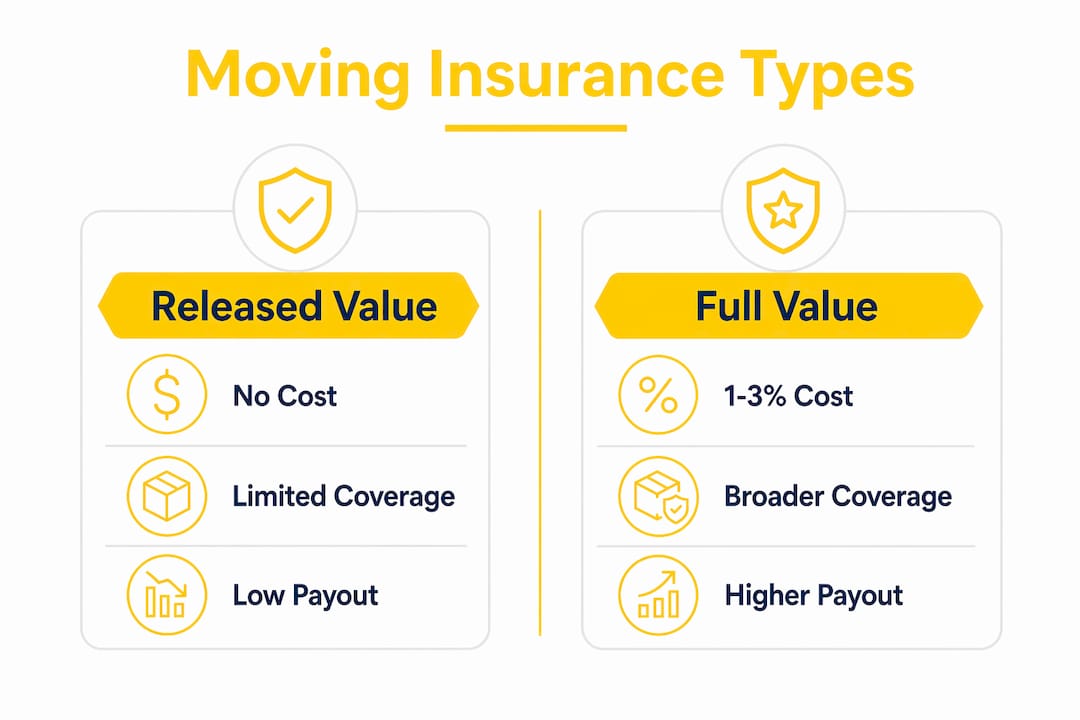
Third-party moving insurance policies sit in a similar price range. Premiums typically fall between 1% and 3% of the declared value, but the coverage scope is broader. Many third-party policies cover items packed by the owner, mechanical or electrical failure without visible external damage, and high-value items that mover liability excludes. For families with art, jewellery, or specialist electronics, this broader scope is worth the comparable cost.
Several factors influence your final premium. The declared value of your shipment is the primary driver. Higher deductibles reduce premiums but increase your out-of-pocket risk. The distance of the move, the number of high-value items declared separately, and the packing method (professional versus owner-packed) all affect pricing. Families relocating interstate should budget for the higher end of the premium range, given the longer transit time and greater handling exposure.
- Declared value of $30,000: expect a third-party premium of $300 to $900
- Declared value of $50,000: expect a premium of $500 to $1,500
- High-value items such as jewellery or fine art require separate riders or specialist policies
- Owner-packed boxes may attract higher premiums or reduced coverage under some policies
What coverage gaps should families watch for when choosing moving insurance?
The most common coverage gap families encounter is the owner-packed box exclusion. Claims on owner-packed boxes are frequently denied unless there is visible external damage to the packaging itself. If you pack your own crockery and it arrives broken inside an undamaged box, the mover’s liability claim will likely be rejected. Third-party insurance can cover this scenario, but you need to confirm it explicitly in the policy wording.
Internal mechanical or electrical failures are another common exclusion under mover liability. If your refrigerator compressor fails after transit but the unit shows no external dents or scratches, the mover owes you nothing under standard valuation. Third-party policies can cover mechanical failure without visible damage, which is a meaningful advantage for families moving appliances and electronics.
High-value items carry their own set of risks. Jewellery, fine art, and items over certain weight thresholds often require a separate declaration and may be excluded entirely from standard mover liability. If you do not declare these items before the move, you have no recourse if they are lost or damaged. Many families discover this limitation only after filing a claim.
Pro Tip: Photograph every item of value before packing, including serial numbers on electronics. Store these images in cloud storage so they are accessible if you need to lodge a claim after the move.
- Owner-packed boxes: reduced or no coverage without visible external damage
- Mechanical and electrical failure: excluded from mover liability unless externally caused
- High-value items: require separate declaration or specialist rider
- Homeowners insurance: transit coverage gaps are common and often overlooked
- Released value default: families who do not actively opt up are left with minimal protection
Relying solely on basic mover liability or assuming your home contents policy covers the move is a risk that is easy to avoid. The gap between what you assume is covered and what is actually covered can run into thousands of dollars.
How can Australian families evaluate and select the right moving insurance?
Selecting the right coverage is a structured process, not a last-minute decision. Working through these steps before moving day gives you a clear picture of your exposure and your options.
-
Inventory your belongings and estimate replacement values. Walk through every room and list items with their approximate replacement cost, not their original purchase price. Focus on electronics, appliances, furniture, jewellery, art, and anything with sentimental or financial value above $500.
-
Ask your removalist specific questions about valuation. Request written details on both Released Value Protection and Full Value Protection, including deductible amounts, claim procedures, and any item exclusions. A reputable removalist will answer these questions without hesitation. Guidance on choosing the right interstate removalist can help you identify which companies take this seriously.
-
Review your homeowners or renters insurance declarations page. Confirm whether transit coverage exists and check the deductible. Many families find their policy either excludes mover-caused damage or carries a deductible that makes small claims unviable.
-
Compare at least two third-party moving insurance policies. Look specifically at owner-packed box coverage, mechanical failure clauses, high-value item limits, and the claims process. A policy regulated by a state insurance commissioner gives you a clearer dispute pathway than a mover’s internal claims department.
-
Document your packing process. If you are packing any boxes yourself, photograph the contents before sealing them. Label boxes clearly and keep a written record. This documentation is your primary evidence if a claim is disputed.
-
Opt up from the default. Released Value Protection is the default on most contracts. You must actively choose Full Value Protection or arrange third-party insurance. Do not assume you are covered because you signed a contract. Read what you signed.
A strong coverage strategy often combines full value protection from the mover, confirmed transit coverage from your homeowners policy, and supplemental third-party insurance for high-value or irreplaceable items. This layered approach closes the gaps that any single policy leaves open.
Key takeaways
Moving insurance is the most cost-effective way to protect family belongings during a relocation, and the right strategy combines mover valuation, homeowners policy confirmation, and third-party coverage for high-value items.
| Point | Details |
|---|---|
| Mover liability is not insurance | Released and Full Value Protection are liability frameworks, not independent insurance policies. |
| Default coverage is dangerously low | Released Value Protection pays roughly $0.60 per pound, which rarely covers replacement costs. |
| Home insurance has transit gaps | Most homeowners policies exclude damage caused by movers handling your belongings. |
| Third-party policies offer broader cover | Independent insurers cover owner-packed boxes and mechanical failure that mover liability excludes. |
| Documentation protects your claim | Photographing belongings and packing contents before transit is your strongest evidence in a dispute. |
Why I think most families get moving insurance completely wrong
From what I have seen working in the removals space, the biggest mistake families make is treating moving insurance as an optional add-on rather than a core part of the move budget. They spend weeks researching removalists, comparing quotes to the dollar, and then accept the default Released Value Protection without reading what it actually covers. That decision can cost them far more than the difference between quotes.
The second mistake is assuming the homeowners policy handles everything. Many consumers mistakenly believe their home insurance automatically protects belongings during a move. It generally does not. I have spoken with families who discovered this only after a claim was denied, which is the worst possible time to learn about a policy exclusion.
What actually works is treating the insurance decision the same way you treat the move itself: as a planned, deliberate process. Inventory your goods, understand the valuation terms your removalist offers, check your existing policy, and fill the gaps with third-party coverage where needed. Industry experts recommend third-party policies especially for long-distance moves, owner-packed items, and valuable or irreplaceable goods. That recommendation is grounded in real claim outcomes, not theory.
The peace of mind that comes from knowing your belongings are properly covered is not a luxury. For a family moving a three-bedroom home worth $50,000 in contents, a third-party premium of $500 to $1,500 is a straightforward investment. The alternative is hoping nothing goes wrong, and hope is not a coverage strategy.
— John
How Easymoveservices supports families through every stage of relocation
Easymoveservices combines real-time tracking technology with personalised packing and moving services, so you always know where your belongings are and how they are being handled. Whether you are moving locally or relocating interstate, the team provides transparent advice on coverage options, helping you understand what your removalist valuation includes and where you may need additional protection.
For families who want practical guidance on selecting a removalist that takes insurance seriously, the Easymoveservices resource on choosing the right interstate removalist walks you through the key questions to ask and the red flags to avoid. Easymoveservices also supports NDIS participants with tailored moving solutions. Get in touch with the team to discuss your upcoming move and make sure your belongings are covered from pickup to delivery, no dramas.
FAQ
What is the role of moving insurance for family belongings?
Moving insurance protects your family belongings from loss, damage, or theft during transit, covering risks that basic mover liability and standard homeowners policies typically exclude. It is the primary financial safeguard for your household goods between your old home and your new one.
Do I need moving insurance if I already have home contents insurance?
Most homeowners and renters insurance policies exclude damage caused by movers handling your belongings during transit, so your existing policy likely does not cover a move. Reviewing your declarations page before moving day confirms whether you have a gap.
How much does moving insurance typically cost in Australia?
Third-party moving insurance typically costs between 1% and 3% of your declared belongings value, while Full Value Protection from a removalist sits in a similar range with deductibles of $250 to $500. For a $50,000 household, that means a premium of roughly $500 to $1,500.
Are owner-packed boxes covered by moving insurance?
Owner-packed boxes are frequently excluded from mover liability claims unless there is visible external damage to the packaging. Third-party moving insurance policies often cover owner-packed boxes, but you need to confirm this explicitly in the policy terms before signing.
What items require specialist moving insurance coverage?
Jewellery, fine art, antiques, and electronics over certain value thresholds often require a separate declaration or specialist insurance rider, as standard mover liability excludes or significantly limits coverage for these items.
Recommended
- How To Prepare Furniture For Movers | EasyMove Services
- Interstate Moving Planning Guide For AU Moves | EasyMove Services
- What Are The Best Tips For Moving Interstate With Ease | EasyMove Services
- What Are 5 Money-Saving Moving House Tips? | EasyMove Services
Article generated by BabyLoveGrowth