

A moving quote is a detailed pricing and service outline provided by a removalist, specifying exactly what work will be performed and at what cost before a single item is lifted. Understanding what a moving quote includes is the difference between a smooth relocation and an invoice that bears no resemblance to the number you agreed on. Most quotes cover base transportation, loading and unloading labour, and standard furniture protection, but the details beyond that vary considerably. Getting clarity upfront is the most practical thing you can do before committing to any removalist.
What does a moving quote include as standard?
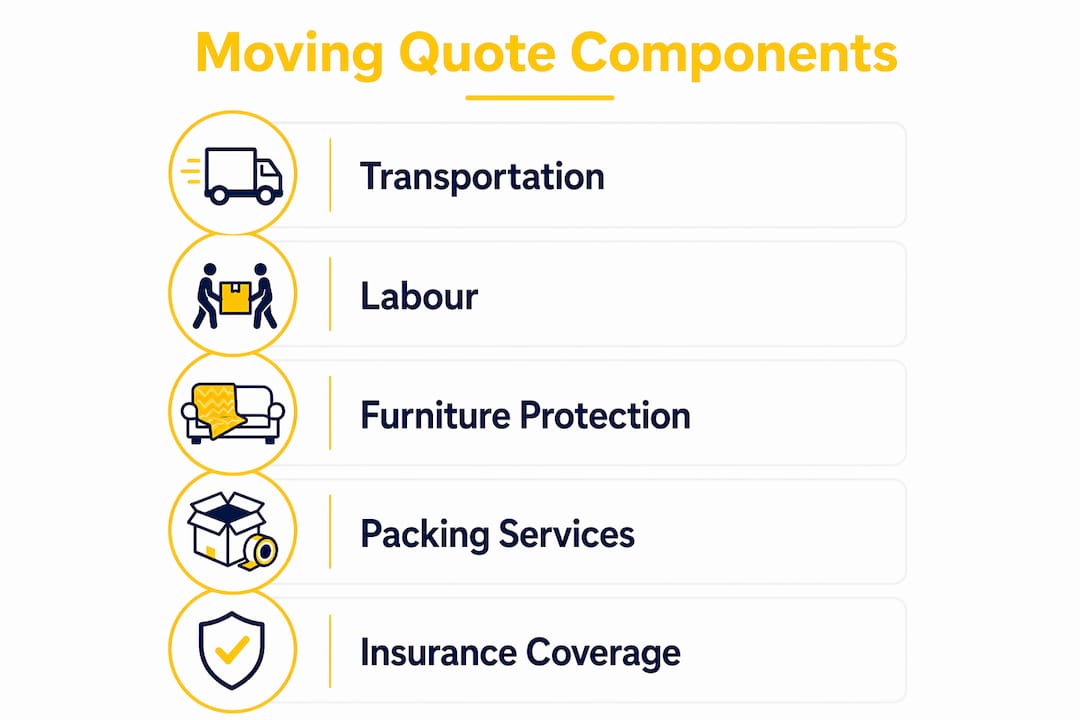
A standard moving quote covers base transportation costs, loading and unloading labour, and standard furniture protection materials. These three elements form the foundation of almost every residential moving estimate in Australia. Knowing what sits inside that base price helps you spot immediately when a quote is missing something it should not be.
Transportation costs include the truck, fuel, and mileage between your origin and destination. Labour charges cover the removalist crew for the time spent loading, transporting, and unloading your belongings. Standard furniture protection typically means moving blankets and basic wrapping applied to larger items during transit.

Labour accounts for approximately 45% of a typical moving bill, with transportation at around 20%, packing at 15%, accessorial fees at 12%, valuation at 5%, and administration at 3%. This breakdown tells you that labour is where most of your money goes, so any quote that seems unusually low on labour hours deserves a closer look.
Scheduling and coordination services are also generally included. This covers the removalist’s time to plan the job, confirm bookings, and organise the crew and vehicle. Standard liability coverage, known as Released Value Protection, is included by default in most quotes, though its limits are far lower than many people expect.
Pro Tip: Ask your removalist to list every line item in the quote before you sign anything. A quote that bundles everything into one lump sum gives you no way to verify what is and is not covered.
How do binding, non-binding, and binding-not-to-exceed quotes differ?
The type of moving quote you receive has a direct impact on what you pay at the end of the job. There are three main quote structures used by removalists, and each one handles price changes differently.
-
Binding estimate. The price is locked in for the services listed. If the job takes longer or requires more crew, the removalist absorbs that cost, provided the inventory and conditions have not changed. This gives you the strongest price certainty.
-
Non-binding estimate. The final invoice is based on actual weight or time, not the original figure. Final charges on non-binding estimates are capped at 110% of the quoted amount at delivery, with any balance payable later. This type is common with online quote tools but offers weaker consumer protection.
-
Binding-not-to-exceed estimate. The price can come in lower than quoted if the actual job is smaller, but it cannot exceed the original figure. This is the most consumer-friendly structure for long-distance moves.
A written, itemised moving estimate is the only document that protects you if a dispute arises. A verbal quote or a rough figure sent by text is not enforceable. Always request a signed, dated estimate that lists transportation, accessorial, and advance charges separately, along with the removalist’s accepted payment methods and cancellation terms.
If your inventory changes after the quote is issued, the removalist is entitled to revise the price. Adding a piano, a large outdoor setting, or a significant number of boxes not in the original list will almost certainly trigger an amended estimate. Notify your removalist of any changes before moving day to avoid surprises at the door.
What extra charges are often left out of the base quote?
Accessorial charges are fees for services outside the standard scope of a move, and they are the most common source of invoice shock. Shuttle fees range from $150 to $500 or more, and stair carry fees typically run $50 to $150 per flight. These figures add up fast in apartment buildings or properties with difficult access.
Common accessorial charges to ask about before signing include:
- Shuttle service. Required when the main truck cannot access your property and a smaller vehicle must relay items.
- Long carry fee. Charged when removalists must carry items more than a set distance from the truck to your door.
- Stair and elevator fees. Applied per flight of stairs or per use of a lift, depending on the removalist’s pricing structure.
- Bulky item handling. Pianos, pool tables, and large gym equipment often attract a separate fee due to the extra labour and equipment required.
- Appliance servicing. Disconnecting and reconnecting washing machines, dryers, or gas appliances is rarely included in a base quote.
- Debris removal. Taking away packing materials or old furniture after the move is almost always a separately charged service.
Packing services are almost never included in a base moving quote and must be requested as an add-on. If you have fragile items, antiques, or artwork, ask explicitly whether professional packing is available and what it costs. You can compare your options by reading about packing versus self-packing to decide what suits your situation and budget.
Pro Tip: Before your removalist visits for a quote, walk through every room and note anything that could create access challenges: narrow hallways, steep driveways, flights of stairs, or items that need disassembly. Flagging these upfront prevents accessorial charges appearing on your final invoice.
What liability and insurance coverage does a moving quote include?
Standard liability coverage included in most moving quotes is Released Value Protection, which compensates at 60 cents per pound per damaged item. For a 10-kilogram television worth $1,500, that translates to a payout of roughly $6. This is not insurance in any meaningful sense of the word.
Released Value Protection is a liability limit, not a policy. It defines the maximum the removalist owes you if something is damaged or lost, and it is set deliberately low to keep base quote prices competitive. Many people assume their goods are fully covered simply because coverage is mentioned in the quote. That assumption is costly.
Full Value Protection is a separate paid add-on that requires the removalist to repair, replace, or compensate you for the full current market value of any damaged or lost item. It is strongly recommended for long-distance moves, high-value goods, or any move involving antiques, electronics, or irreplaceable items. The cost varies by removalist but is typically calculated as a percentage of the declared value of your goods.
You can also arrange separate transit insurance through a third-party insurer, which may offer broader coverage than what removalists provide directly. Check whether your home and contents policy covers goods in transit before your move date, as some policies include this automatically.
Pro Tip: Always declare the replacement value of your most valuable items in writing before the move. This creates a documented baseline if you need to make a claim, regardless of which coverage type you have chosen.
How do you compare moving quotes to avoid low-ball surprises?
Comparing moving quotes accurately requires that every quote covers an identical scope of work. The lowest quote usually reflects a narrower scope of services rather than greater operational efficiency. A quote that looks $300 cheaper may simply exclude packing, stair fees, or full liability coverage that the higher quote includes.
The table below shows the key factors to check when comparing quotes side by side.
| Factor | What to check |
|---|---|
| Inventory basis | Is the quote based on a full item list or a rough room count? |
| Quote type | Binding, non-binding, or binding-not-to-exceed? |
| Accessorial fees | Are stair, shuttle, and long carry fees listed separately? |
| Packing services | Is professional packing included or quoted as an add-on? |
| Liability coverage | Released Value or Full Value Protection? |
| Survey method | In-home inspection or phone/online estimate only? |
In-home or thorough virtual surveys produce more accurate and enforceable quotes than phone estimates based on room counts. A removalist who quotes without seeing your inventory is estimating, not quoting. That distinction matters when the final invoice arrives.
Ask every removalist the same set of questions: What is included in the base price? What triggers an accessorial charge? What is your liability coverage and what does it pay? How do you handle changes to the inventory after the quote is issued? Written answers to these questions give you a genuine basis for comparison. For a practical starting point, use a moving quote calculator to understand the cost components before you contact removalists directly.
Key takeaways
A moving quote covers base transportation, labour, and standard protection, but the final cost depends entirely on what is listed, what type of quote you hold, and what accessorial charges apply to your specific property and inventory.
| Point | Details |
|---|---|
| Base quote components | Transportation, labour, and basic furniture protection are standard inclusions in most quotes. |
| Quote types matter | Binding estimates lock the price; non-binding estimates can rise up to 110% of the quoted figure. |
| Accessorial charges add up | Shuttle, stair, and long carry fees are often excluded and can add hundreds to the final invoice. |
| Default liability is minimal | Released Value Protection pays 60 cents per pound per item, not the replacement value of your goods. |
| Compare identical scopes | The cheapest quote often covers fewer services; match inclusions before comparing prices. |
Why the quote conversation is the most important part of your move
I have seen more moves go sideways over quote misunderstandings than over any other single issue. The pattern is almost always the same. A customer accepts the lowest figure, assumes it covers everything, and then receives an invoice on moving day that includes shuttle fees, stair charges, and packing materials that were never discussed. The frustration is real, and it is entirely avoidable.
The biggest mistake people make is treating a rough figure as a binding written estimate. Equating a vague quote with a binding estimate is the most common and costly consumer error in the moving industry. A number sent via email without a signed, itemised breakdown is not a quote in any enforceable sense.
What actually works is treating the quoting process like an operational project. Walk every room with the removalist or their virtual survey tool. List every item, flag every access challenge, and ask explicitly about packing, liability, and accessorial fees. Inventory detail accuracy is the single biggest driver of quote accuracy because removalists price individual items, not rooms.
My honest advice is to get at least three written, itemised quotes based on the same full inventory. If one quote is significantly lower than the others, ask what it excludes before assuming you have found a bargain. The removalist who takes the time to survey your home properly and answer your questions clearly is almost always the better choice, regardless of whether they are the cheapest on paper.
— John
Move with confidence using Easymoveservices
Planning a move and unsure whether your quote covers everything it should? Easymoveservices takes the guesswork out of the process with transparent, itemised quotes based on a thorough assessment of your inventory and property access. Every quote clearly separates base services from optional add-ons like professional packing services, so you know exactly what you are paying for before moving day.

Easymoveservices combines real-time tracking technology with personalised moving and packing services across Melbourne and beyond, including support for NDIS participants. Whether you are moving locally or interstate, you can choose the right removalist with confidence, knowing your quote is detailed, honest, and built around your actual needs. Get in touch with Easymoveservices today for a personalised quote with no dramas.
FAQ
What is typically included in a moving quote?
A standard moving quote includes base transportation costs, loading and unloading labour, basic furniture protection, standard liability coverage, and scheduling coordination. Packing services and accessorial charges like stair or shuttle fees are almost always listed separately.
What is the difference between a binding and non-binding moving estimate?
A binding estimate locks the price for the listed services regardless of actual time or weight. A non-binding estimate can increase based on actual conditions, though the amount payable at delivery is capped at 110% of the original quoted figure.
Are packing services included in a moving quote?
Packing services are rarely included in a base moving quote. You need to request professional packing as a separate add-on and confirm the cost during the quoting stage, particularly for fragile or high-value items.
What does standard liability coverage in a moving quote actually cover?
Released Value Protection, the default liability included in most quotes, compensates at 60 cents per pound per damaged item. For full replacement value coverage, you need to opt into Full Value Protection or arrange separate transit insurance.
How do I get an accurate moving quote?
Request an in-home or detailed virtual survey based on a complete item inventory rather than a room count. Ask for a written, itemised estimate that separates transportation, labour, accessorial fees, and liability coverage so you can compare quotes on equal terms.
Recommended
- Moving Quote Calculator Melbourne Guide | EasyMove Services
- Local Or Regional Moving Rates | EasyMove Services
- Interstate Moving Planning Guide For AU Moves | EasyMove Services
- What Are Top Moving Trends For 2021 | EasyMove Services