

A professional home moving service is a full-service relocation solution where trained, insured specialists manage every major stage of your household move, from packing and loading through to transport, unloading, and furniture placement. Unlike hiring a ute and a few mates, a professional removalist treats your move as an operational project with a coordinated plan, dedicated equipment, and clear accountability. For families and individuals planning a relocation in 2026, understanding exactly what this service covers, and how it differs from cheaper alternatives, is the clearest path to a move that goes without a hitch.
What does a professional home moving service include?
A full-service moving package covers packing supplies and materials, professional packing techniques, loading and unloading labour, transport, and furniture placement at your destination. Most providers also offer optional extras such as unpacking, debris removal, and short or long-term storage. The scope is broad by design. One coordinated team handles what would otherwise require you to manage multiple contractors on your own.
Professional packing is one of the most underrated parts of the service. Removalists use room-by-room packing, systematic labelling, and protection materials matched to each item’s fragility and size. This approach reduces unpacking time and damage risk significantly compared to self-packing. For families with fragile heirlooms, artwork, or large appliances, this alone often justifies the cost.

Furniture disassembly and reassembly is standard with most full-service providers. Beds, wardrobes, modular workstations, and flat-pack shelving are dismantled before the load and rebuilt at the destination. Specialty handling covers bulky or high-value items such as pianos, safes, and antiques, which require purpose-built equipment and trained technique.
Pro Tip: Book a home preparation consultation before moving day. Knowing which items need special handling in advance lets your removalist bring the right equipment and avoids costly delays on the day.
How does a professional move differ from labour-only moving?
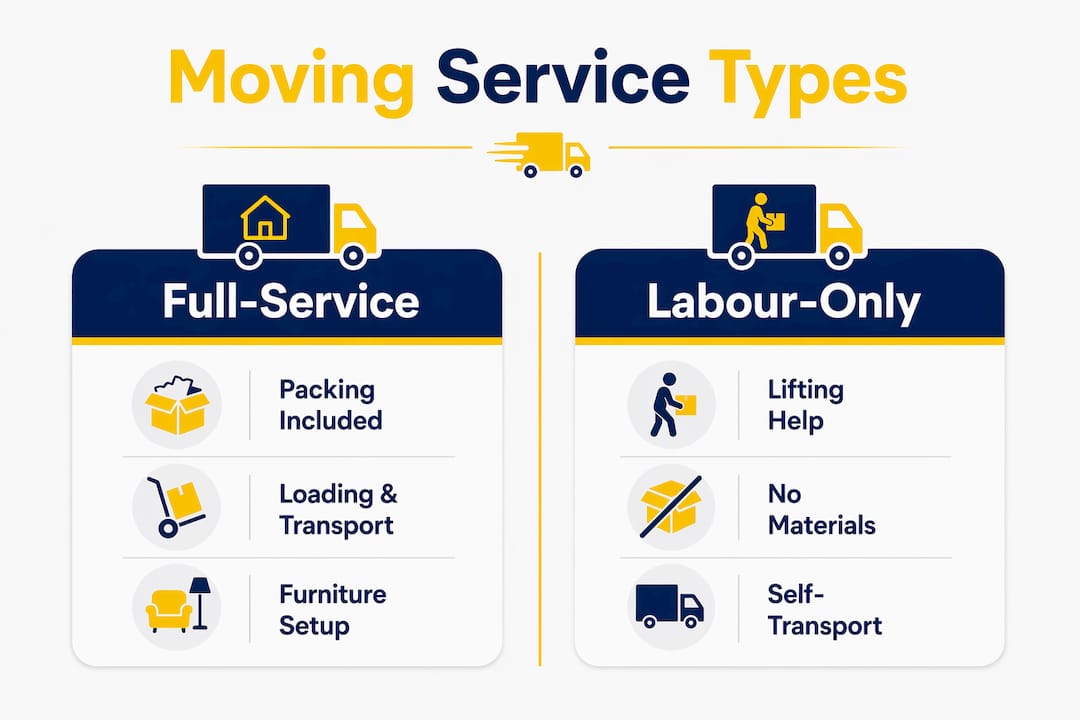
Labour-only movers provide a crew for heavy lifting only. You arrange your own truck hire, packing materials, and transport logistics. Labour-only is booked by the hour with a typical minimum of two hours. Full-service movers handle all stages under one coordinated plan, which means one quote, one point of contact, and one team responsible for the outcome.
The pricing structure reflects this difference. Labour-only costs less upfront but requires you to budget separately for truck hire, packing supplies, and your own time. Full-service moving carries a higher total cost but removes the coordination burden entirely. For families pressed for time or moving long distances, the full-service model delivers clear value.
| Feature | Full-service moving | Labour-only moving |
|---|---|---|
| Packing and materials | Included | Customer arranges |
| Transport | Included | Customer arranges |
| Furniture disassembly | Included | Often included |
| Unpacking | Optional add-on | Not included |
| Pricing structure | Fixed coordinated plan | Hourly rate |
| Best suited to | Families, long-distance, complex moves | Budget-conscious, local, small loads |
| Accountability | Single team | Split across providers |
Labour-only suits renters moving a small apartment locally, or customers who prefer to pack their own belongings. Full-service is the right call for large households, interstate relocations, or anyone who values having a single accountable team manage the process from start to finish.
What is valuation protection and why does it matter?
Valuation protection defines how much a moving company is liable to pay if your belongings are lost or damaged during the move. Two options exist under standard moving contracts. Released Value Protection caps the mover’s liability at 60 cents per pound per article, regardless of the item’s actual worth. Full Value Protection requires the mover to repair, replace, or reimburse up to the declared value of any damaged or lost item.
Released Value is the default option and costs nothing extra. That sounds appealing until you realise a 5-kilogram laptop worth $2,500 would attract compensation of less than $7 under this scheme. High-value but lightweight items are particularly exposed. Declaring their value and upgrading to Full Value Protection is the practical choice for anyone moving electronics, jewellery, or artwork.
The distinction between valuation coverage and insurance is equally important. Valuation is contractual carrier liability under law, not an insurance product. Separate moving insurance is purchased from licensed third-party insurers and provides broader protection. Reading your moving contract before signing is non-negotiable. Default options often limit compensation in ways that are not obvious at first glance.
- Released Value Protection: No additional cost; liability capped at 60 cents per pound per article.
- Full Value Protection: Additional cost; mover must repair, replace, or reimburse up to declared value.
- Third-party insurance: Purchased separately; covers scenarios valuation may not, including acts of nature.
- Declared value: You nominate the total value of your shipment; this affects your protection level and cost.
Pro Tip: Before signing any moving contract, check whether moving interstate with valuables requires you to declare individual high-value items separately. Some contracts require item-level declarations to activate Full Value Protection.
How does the professional home moving process work?
A professional move follows a clear sequence. Treating it as an operational project rather than a simple transport task is what separates a smooth relocation from a stressful one.
-
In-home survey and planning. A free in-home estimate covers your full inventory, packing requirements, specialised materials needed, furniture disassembly, access points, and parking logistics. This assessment produces an accurate quote and a realistic timeline.
-
Scheduling and logistics. The moving company coordinates truck size, crew numbers, and travel route based on your survey. For interstate moves, this includes compliance checks and load sequence planning.
-
Packing day. Removalists arrive with all materials and pack room by room using a labelling system that identifies contents and destination room. Fragile items receive individual wrapping and dedicated boxes. Professional packing techniques protect your belongings and make unpacking at the other end far more manageable.
-
Loading and transport. Items are loaded in a planned sequence, with heavy furniture first and fragile boxes secured last. Professional trucks are fitted with tie-down points, padding, and load restraints. The driver manages the route and delivery schedule.
-
Unloading and placement. At the destination, the crew unloads and places furniture in the rooms you specify. Beds are reassembled, appliances are positioned, and boxes are placed in the correct rooms.
-
Optional unpacking and cleanup. Full-service providers can unpack boxes, remove packing materials, and arrange for storage of items you are not yet ready to place. This is particularly useful for families with young children or tight move-in schedules.
Pro Tip: Walk through your new home with the crew leader before unloading begins. Pointing out where each piece of furniture goes takes five minutes and saves hours of repositioning later.
What are the key benefits of hiring professional movers?
Shifting packing, loading, transport, and placement to one team lowers your time burden and stress compared to managing multiple service providers separately. That single point of accountability is one of the clearest advantages of full-service moving. If something goes wrong, you have one contact to resolve it.
Professional movers carry liability insurance and operate with trained crews who understand load sequence, weight distribution, and safe handling technique. This expertise reduces the risk of damage to your belongings and to the properties at both ends of the move. Scratched floors and doorframe damage are common with DIY moves and far less common with experienced removalists.
Access to specialised equipment is another practical benefit. Furniture dollies, stair climbers, piano boards, and vehicle ramps are standard tools for professional crews. Hiring or sourcing this equipment yourself adds cost and complexity to a DIY move. For complex, long-distance, or large household relocations, the equipment and expertise of a professional team make a measurable difference to the outcome.
Key takeaways
A professional home moving service delivers the most value when you treat it as a coordinated operational project, not just a transport booking.
| Point | Details |
|---|---|
| Full-service scope | Includes packing, loading, transport, unloading, placement, and optional unpacking. |
| Labour-only difference | Labour-only provides crew only; you arrange transport, packing, and logistics separately. |
| Valuation protection | Default Released Value caps liability at 60 cents per pound; upgrade to Full Value Protection for real coverage. |
| Moving process | Starts with an in-home survey and follows a planned sequence through to furniture placement. |
| Key benefit | One accountable team reduces stress, damage risk, and coordination effort across the whole move. |
What I have learned from watching families move
After years of observing how home moves play out, the biggest mistake I see families make is treating the moving company as a last-minute booking rather than a planning partner. Most people spend weeks researching suburbs and schools, then call a removalist three days before the move. That gap between planning effort and booking timing causes more problems than almost anything else.
The second mistake is misreading the valuation section of the moving contract. Customers assume they are covered for the replacement value of their belongings by default. They are not. Released Value Protection is the default, and it covers almost nothing for lightweight, high-value items. I have spoken to families who discovered this only after a claim was rejected.
On the cost versus value question: full-service moving is not cheap, but the comparison point should not be labour-only. It should be the total cost of a DIY move, including truck hire, packing materials, your time, and the risk of damage. When you add those up honestly, the gap narrows considerably. For a family moving interstate with a full household, professional packing services often pay for themselves in reduced breakage alone.
The practical tip I give everyone: prepare your home before the crew arrives. Clear pathways, dismantle flat-pack furniture you can manage yourself, and have a clear list of items that need special handling. That preparation shortens the job and reduces your bill.
— John
How Easymoveservices can support your next home move
Easymoveservices combines live tracking technology with personalised packing and moving services, so you always know where your belongings are during transit. Whether you are moving locally or interstate, the team handles packing, loading, transport, and placement under one coordinated plan. Easymoveservices also supports NDIS participants with tailored moving assistance.
If you are planning an interstate relocation and want to choose the right removalist with confidence, the Easymoveservices guide to choosing an interstate removalist walks you through exactly what to look for, what questions to ask, and how to compare quotes fairly. No dramas, just a clear path to your next home.
FAQ
What does a professional home moving service include?
A professional home moving service covers packing, loading, transport, unloading, and furniture placement as standard. Optional extras include unpacking, debris removal, and storage.
How is full-service moving different from labour-only?
Labour-only movers provide a crew for lifting only, while full-service movers handle packing, transport, and placement under one coordinated plan.
What is Released Value Protection in a moving contract?
Released Value Protection is the default valuation option, capping mover liability at 60 cents per pound per article. It costs nothing extra but provides minimal compensation for high-value items.
How far in advance should I book a professional removalist?
Booking four to six weeks ahead is standard for local moves. Interstate relocations benefit from eight or more weeks of lead time to allow for survey, scheduling, and logistics planning.
Are professional movers insured?
Licensed professional movers carry liability insurance as a standard requirement. Valuation coverage is included in the contract, while separate moving insurance can be purchased from third-party insurers for broader protection.
Recommended
- Hire A Professional Moving Company – The Number 1 Best Tip For Moving House
- Why Hire Packers For Your House Move
- Professional Movers For Large Families: A Smart Move
- Removalists In Melbourne Within Home